How to draw pixel art smoke
Pixel art smoke is a cluster of round balls in two or three flat shades of one colour, lit from one side, with no soft edges. A puff grows fast, swells, sinks a step darker and breaks into a few small balls before it is gone; a column is the same balls rising, drifting and thinning.
Smoke is everywhere in games: a puff where a character lands, a chimney over a village, a burning car, a cannon’s shot, a spell fizzling out. Drawn badly, it is a grey smudge that hides what is behind it. Drawn as pixel art, it is a handful of round balls in two or three flat shades, and it reads at any size.
A puff is round balls, not a cloud
- Balls of different sizes. Five to ten circles overlapping, one or two big ones in the middle and smaller ones round the edge. One big blob reads as a rock; evenly sized balls read as grapes.
- One light, two or three shades. The light shade on the top of each ball, on the side the light comes from, the middle shade for the rest, a darker one underneath and where balls tuck behind each other. Each ball is shaded on its own, so the puff keeps its lumps.
- Hard edges. No soft brush, no gradient round the edge, no transparency. If smoke must be thin, make it fewer and smaller balls, not see-through ones.
- A dark rim or none. An outline in the darkest shade (or the game’s line colour) keeps a small puff readable over a busy background. Thin, high smoke can do without one.
The frames of a puff
A puff is all timing. Here is a smoke puff rendered by Pixor at 64 pixels, eight frames, left to right and top to bottom:
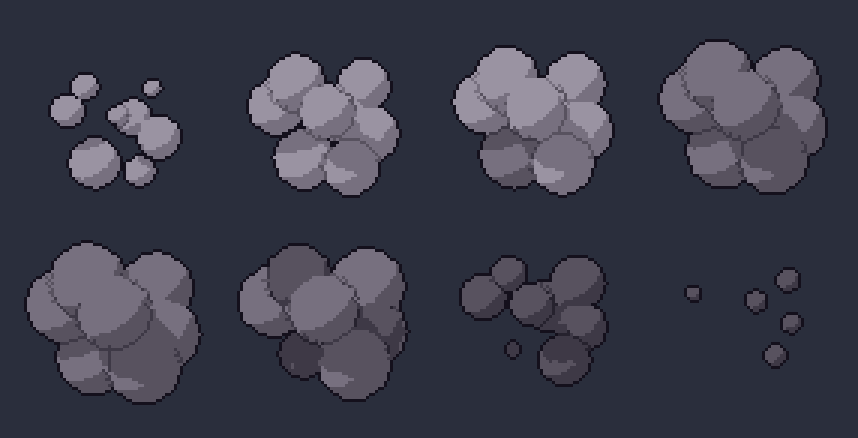
- Appear. A few small balls, already apart. A puff that starts as one dot and grows reads as a balloon.
- Swell. Two or three frames, the balls growing and merging into one lumpy cluster. This is the fastest part: most of the size arrives in the first third.
- Age. The cluster keeps its size but goes a shade darker and loses its light side, as smoke does when it cools.
- Break up. The last frames are a few small, dark balls drifting apart, then nothing. Smoke that shrinks evenly to a point looks like it is being sucked back in.
At 12 frames a second, eight frames is two thirds of a second. A dust puff under a foot can be four; the smoke after an explosion can take twelve or more and rise as it ages.
Smoke colours
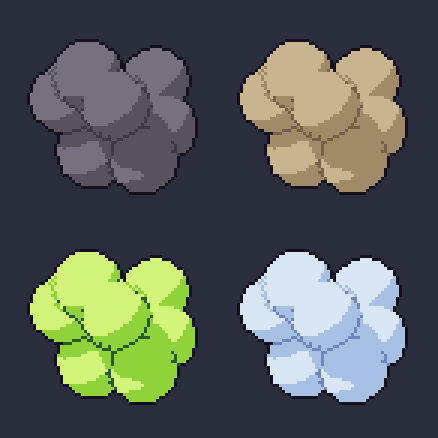
Smoke is never neutral grey. Pick a ramp of two or three shades with a tint, and shift its hue the way light does: lighter shades warmer, darker shades cooler. The same puff in four ramps:
| Smoke | Ramp | Where |
|---|---|---|
| Wood and campfires | warm grey, a touch of brown | villages, camps, torches |
| Dust | sand to brown | footsteps, landings, cars on dirt |
| Oil, tyres, burning metal | near black, cool | wrecks, engines, war games |
| Steam | white, with blue or lilac shadows | kettles, vents, hot springs, trains |
| Poison and magic | a saturated colour with a light core | gas traps, spells, swamp |
Keep the background darker or lighter than the smoke’s middle shade, and keep each ramp in the game’s palette. Smoke that is the same value as the sky behind it disappears.
Columns, chimneys and trails
A rising column is the same balls made one after another: each is born small near the source, grows as it rises, drifts to one side and breaks up near the top. Here is the campfire from the free library with a column over it, four frames of its loop:
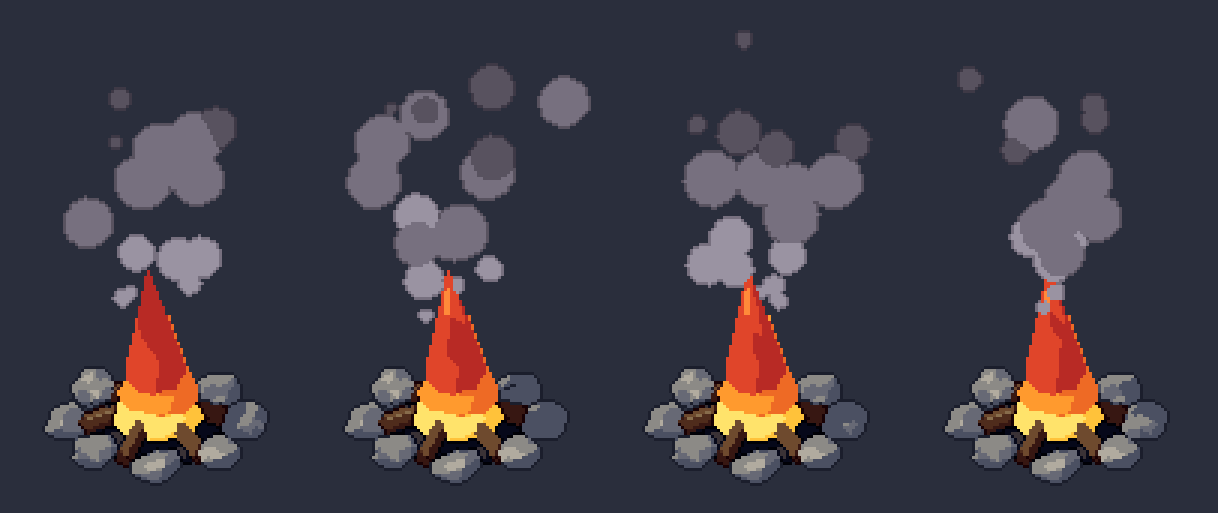
- Small at the bottom, big at the top. Smoke spreads as it rises. A column that keeps its width looks like a pipe.
- Fewer balls higher up. The top of the column is a few separate balls, so it thins away rather than stopping.
- A loop, not a shot. Make the balls on a steady rhythm so the column loops: a new one every two or three frames, each living for most of the loop.
- Left behind. Smoke from something moving stays where it was made: a car’s exhaust, a rocket’s trail, the dust of a runner. In a sheet drawn in place, the old puffs slide back across the frames while the sprite stays still.
Making smoke with Pixor
Pixor draws smoke as round particles, each shaded as a ball in the sprite’s own palette, light and lines, so it belongs in the same game as the model. A puff on its own, as its own sprite sheet:
pxr effect "smoke-puff:10,1.count=9,1.radius=0.35,ramp=smoke" --preset clean --size 64 -o puff.pngsmoke-puff:10is a puff of ten frames, andramp=its colours:smoke,dust,poison,snow,shadow… or your own#rrggbbcolours, dark to light.1.count=9,1.radius=0.35makes it nine balls spread over 35 centimetres, the cluster on this page, rather than a few big ones.
On a model, --effect "steam:16,ramp=smoke,size=2,at=0,0.5,0,fit" puts a rising column half a metre over its origin, as on the campfire here, and --effect "smoke-puff@Fire:Gun+1" puffs from the part Gun on frame 1 of the clip Fire. Add world to leave the puffs where they were made while the model moves on. For heavy smoke from a simulation, Pixor also opens the .vdb files Blender bakes, as in fire and smoke from a Blender simulation. Every setting is in the manual’s pixel effects.
Questions
How do you draw smoke in pixel art?
As a cluster of circles, not one blob and not a soft cloud: five to ten round balls of different sizes overlapping, each lit from the same side with a light shade on top and a darker one underneath. Two or three shades of one colour are enough. Leave out gradients and blur: the round shapes are what make it read as smoke.
How many frames does a pixel art smoke puff need?
Six to ten. One or two to appear as a few small balls, two or three swelling to full size, two going a shade darker and losing their light side, then one or two of small balls drifting apart and gone. At 12 frames a second that is half a second to under a second.
What colours should pixel art smoke be?
Grey with a tint, never neutral grey: warm grey-brown for smoke from wood, blue-grey for cold or industrial smoke, near black for oil and burning vehicles, white with blue shadows for steam. Use two or three shades of one hue-shifted ramp, and darken the whole puff as it ages.
Should smoke have an outline in pixel art?
A dark outline helps a small puff read over a busy background, and suits games where everything is outlined. Over a plain sky, or for thin smoke from a chimney, leave it out and let the shade underneath the balls do the work.
How do I make smoke trail behind a moving sprite?
Draw each puff where it was born, not where the sprite is now: the puffs stay in the world while the car, rocket or runner moves on. In a sprite sheet drawn in place, they slide back across the frames as fast as the sprite moves forward.