Slime free 3D model & sprite sheet
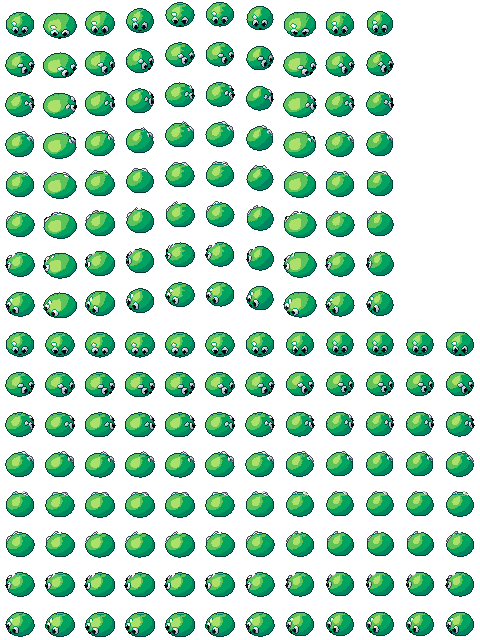
2D pixel art by Pixor, from the 3D model
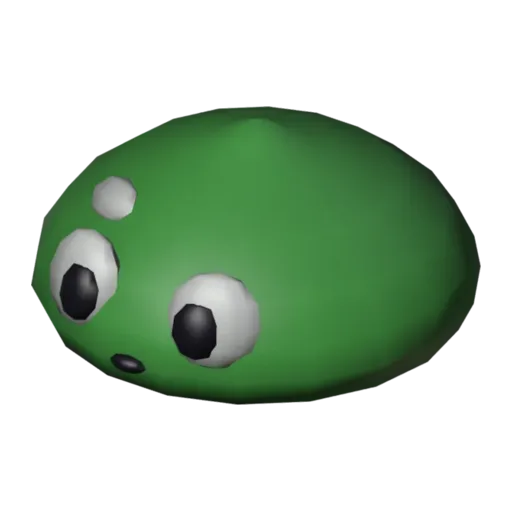
3D the model it was rendered from

GIFs to share
For a devlog, a post or a Discord message. CC0 like the rest: no credit needed.
A glossy green slime with big eyes and a little shine, shaped like a gumdrop with a small tip. Two clips: Idle is a slow, breathing squash that loops, and Hop squashes, jumps, lands and loops. Rendered at 40 pixels from eight sides (or four), with its base on the ground.
The body is a smooth lathe shape. Squash and stretch come from shape keys, while location keys lift the root for the jump, so both follow one timing. The eyes sit high on the body so they look straight at a camera looking down at three-quarters.
Slimes are the first enemy in countless RPGs and action games: slow, harmless and fun to bounce on. Use Idle when it waits and Hop to move it between tiles. The four-side sheet covers top-down movement in each direction, and the hop’s landing frame is a natural moment to deal contact damage.
Change the Slime material to red, blue or purple for stronger types, and scale it up for a king slime boss. It shares its world with the skeleton as a second enemy, and fits in a grassy meadow with the bush and grass tuft.
Use it in your game
- Godot 4:
godot/slime-selout-40.tresis aSpriteFramesresource with 16 animations (Hop_South, Hop_Southeast … Idle_Southwest): drop it on anAnimatedSprite2Dand playHop_South. - Aseprite:
aseprite/slime-selout-40.asepritehas a tag for each of those, 176 frames in all, to touch up by hand; its.jsonsits next to it. - Unity, GameMaker and the rest:
sprites/selout/slime-40px-8-sides.pnghas 16 rows of 40×40 px cells, one per action and side, South (front) first. A 4-side sheet and the 32, 48 and 64 px sizes are next to it. - Posts and devlogs: the GIFs above, also in the zip’s
gifs/folder. - 3D: the GLB opens in Blender, Godot, Unity and three.js. The
.blendkeeps its modifiers, named parts and materials.
How this look was made
The sprite above is Pixor’s selective outline look. In Pixor every step of a look is a node you can change: the light bands, the outlines, the palette. This is that look’s Style graph:

- dither
- 0
- fill
- 0
- hysteresis
- 0.05
- min highlight
- 2
- rim
- none
- shadows
- on
- specular
- 0.96

- convex
- none
- crease
- selout1
- crease angle
- 55
- depth jump
- 2.5
- inner
- selout2
- min inner line
- 3
- outer
- selout3
- outer inside
- off
- part lines
- on


The other looks in the player (clean, retro, flat) are other Style graphs. With Pixor you can open this asset, change any node, and render your own.