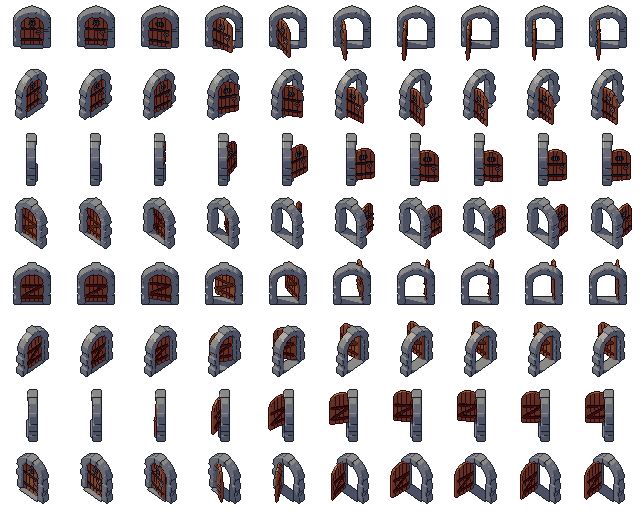
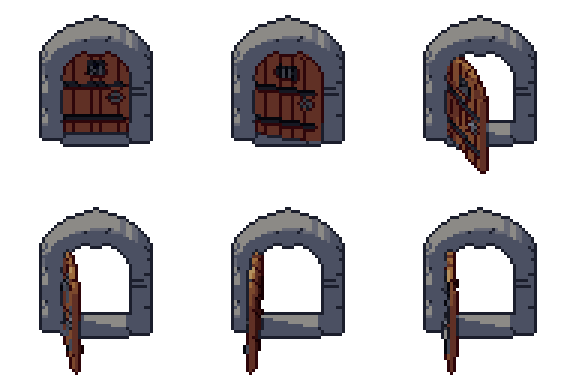
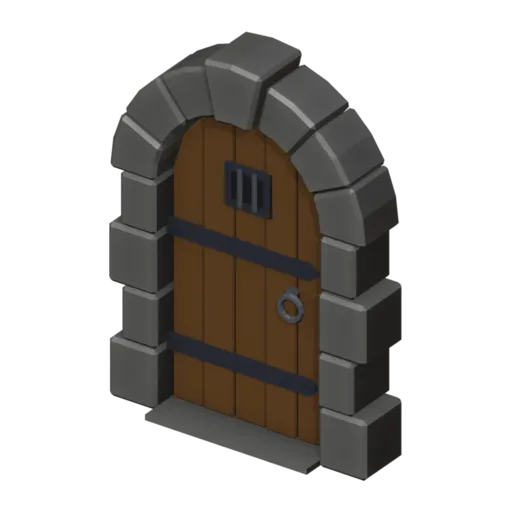
Dungeon door free 3D model & sprite sheet
2D pixel art by Pixor, from the 3D model
3D the model it was rendered from

GIFs to share
For a devlog, a post or a Discord message. CC0 like the rest: no credit needed.
An arched plank door with iron straps, a small barred window and a ring pull, hinged in a stone frame. The Open clip swings it open over ten frames. Rendered at 64 pixels from eight sides (or four), it can face into a room from any wall.
The opening is an arch, framed by stone voussoirs with a keystone that stands proud, and the planks are cut to match its curve. The door itself is a hinged part on a pivot empty, so it swings around its edge rather than its centre. Bevel modifiers soften the frame stones and planks.
Doors are gates between rooms in dungeon crawlers, roguelikes and metroidvanias, often locked until the player finds a key. Play Open when unlocked and hold the final frame. The four main sides let it sit in north, south, east or west walls of a top-down room.
Change the Wood material for a darker or painted door, or the Stone for a different dungeon, such as sandstone for a desert tomb or mossy grey for sunken ruins. The door goes with the key, the wall torch on either side, and the treasure chest waiting beyond.
Use it in your game
- Godot 4:
godot/door-selout-64.tresis aSpriteFramesresource with 8 animations (Open_South, Open_Southeast … Open_Southwest): drop it on anAnimatedSprite2Dand playOpen_South. - Aseprite:
aseprite/door-selout-64.asepritehas a tag for each of those, 80 frames in all, to touch up by hand; its.jsonsits next to it. - Unity, GameMaker and the rest:
sprites/selout/door-64px-8-sides.pnghas 8 rows of 64×64 px cells, one per action and side, South (front) first. A 4-side sheet and the 32 and 48 px sizes are next to it. - Posts and devlogs: the GIFs above, also in the zip’s
gifs/folder. - 3D: the GLB opens in Blender, Godot, Unity and three.js. The
.blendkeeps its modifiers, named parts and materials.
How this look was made
The sprite above is Pixor’s selective outline look. In Pixor every step of a look is a node you can change: the light bands, the outlines, the palette. This is that look’s Style graph:

- dither
- 0
- fill
- 0
- hysteresis
- 0.05
- min highlight
- 2
- rim
- none
- shadows
- on
- specular
- 0.96

- convex
- none
- crease
- selout1
- crease angle
- 55
- depth jump
- 2.5
- inner
- selout2
- min inner line
- 3
- outer
- selout3
- outer inside
- off
- part lines
- on


The other looks in the player (clean, retro, flat) are other Style graphs. With Pixor you can open this asset, change any node, and render your own.