How to draw a pixel art fireball
A pixel art fireball is a round head near white, ringed in yellow and orange, with a ragged tail of red flame pointing back along its path. It flies on a short loop of four to eight frames where the tail flickers and the head barely changes, and it ends in a flash and a small explosion where it lands.
A fireball is the first spell of half the games ever made: the wizard’s attack, the dragon’s breath in a ball, a cannon’s shot in a fantasy game, a hazard a boss throws. It is a small sprite, but it is on screen a lot, and a weak one makes the whole fight look cheap. Drawn as pixel art, it is two shapes, a head and a tail, in three or four flat colours.
A head and a tail
- The head. A round shape at the front, the lightest colour in the middle (white with a warm tint, never pure white over many pixels), ringed by yellow, then orange. This is what the eye follows.
- The tail. Behind the head, pointing back along the path, a narrowing flame in orange and dark red, two or three times as long as the head. Its edge is ragged: notches, a pixel or two broken off at the tip.
- One light, no outline. The fireball is the light, so it has no shading from a lamp and no dark outline round it. The darkest red at the tail’s edge does the outline’s work.
- Hard edges. No soft glow round the head and no transparency. Glow comes from what the fireball lights, not from a halo (see glow in pixel art).
The flying loop
A fireball in flight is a short loop that plays while it moves. Here is Pixor’s fireball at 48 pixels, eight frames, left to right and top to bottom:
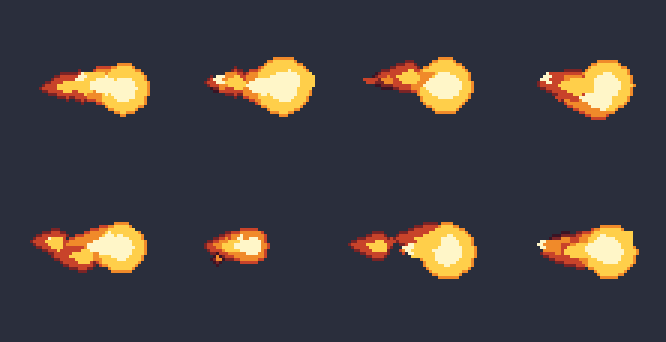
- The head holds still. It keeps its size and place in the cell; the game moves the sprite, not the frames.
- The tail moves. Every frame its shape changes: longer, split in two, a piece breaking off. This is where the fire is.
- One frame smaller. A frame where the whole fireball is a little smaller, the sixth here, makes it flicker like a flame, not pulse like a ball.
- Bright pixels behind. A white or yellow pixel or two left behind the tail say it is going fast.
At 12 frames a second, eight frames loop in two thirds of a second. A small fireball can do with four frames; a slow, big one can take more.
Colours
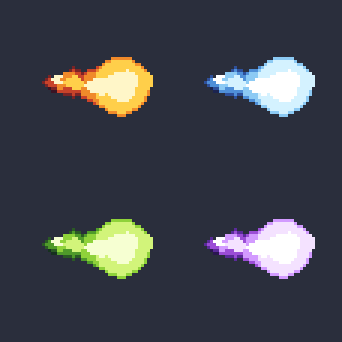
The same shapes in other ramps are the other projectiles of a game. Keep three or four steps of one hue-shifted ramp, the head lightest and warmest, the tail darker and cooler:
| Projectile | Head | Tail |
|---|---|---|
| Fireball | warm white, yellow | orange, deep red |
| Frost bolt | white | light blue, deep blue |
| Poison or acid | pale yellow-green | green, dark green |
| Magic missile | white, lilac | purple, deep violet |
| Hellfire, shadow | pale pink or green | black-purple |
In a game with many projectiles, give the player’s a colour no enemy uses, and keep the tail’s darkest step darker than every background it flies over.
The hit
What sells a fireball is where it lands. A projectile that just vanishes feels like a miss. Here a fireball flies in and bursts, rendered at 96 pixels, eight frames of fourteen:
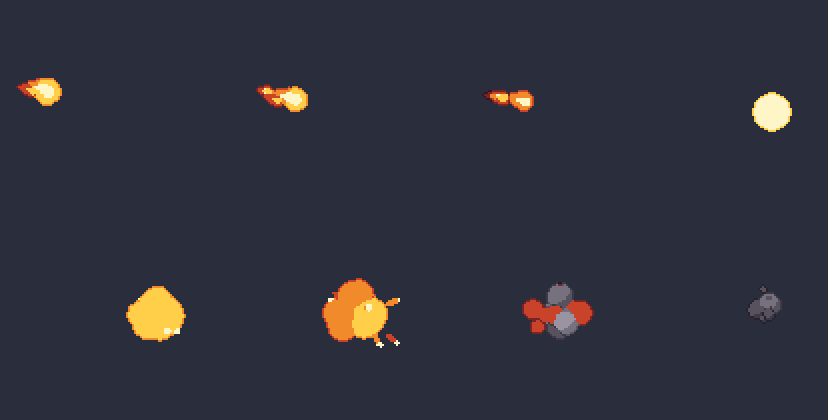
- Flash. One frame of a plain round shape in the lightest colour, bigger than the fireball. It reads as the impact even at 16 pixels.
- Burst. Two or three frames of fire growing out of the flash, a few sparks flying off.
- Smoke. The fire cools to dark red and grey smoke, then breaks into a few balls and is gone.
The burst is a small explosion sprite sheet: six to ten frames, played once where the fireball touched, while the fireball’s own sprite is removed. Dropped from the sky with a rock inside, the same fire is a meteor, and its strike adds a ring along the ground, rocks and a crater.
Making fireballs with Pixor
Pixor draws the fireball as an effect, in the same pixels, palette and light as your models. The loop above, on its own:
pxr effect "fireball:8,ramp=fire" --preset selout --size 48 -o fireball.pngfireball:8is a loop of eight frames, flying along+x, andramp=its colours:fire,frost,poison,magic… or your own#rrggbbcolours, dark to light.- A recipe chains effects with
>:"fireball:6,path=-1.6,0.4,0:0,0,0>explosion:8@land"flies the fireball down a path and starts the explosion where it lands, the hit above in one sheet. magic-missileflies the same way, andmuzzle-flashis the flash where a shot starts.
On a model, --effect "fireball@Cast:Hand+3" puts it at the bone or part Hand from frame 3 of the clip Cast, drawn in place for the game to move; add path=0,0,0:3,0,0,arc=1,land=explosion and it flies three metres in an arc from the hand and bursts where it lands, so the caster and the whole spell come out of one render. Every setting is in the manual’s pixel effects.
Questions
How do you draw a fireball in pixel art?
As a round head and a tail. The head is a circle of the lightest colour, almost white with a warm tint, ringed by yellow and then orange. Behind it, a tail that narrows to a point in orange and dark red, with ragged edges and a pixel or two breaking off. Three or four colours of one hue-shifted ramp are enough; leave out soft glows and gradients.
How many frames does a pixel art fireball animation need?
Four to eight for the flying loop, at 10 to 12 frames a second. The head stays nearly the same size; the tail changes shape every frame, and one frame a little smaller than the others makes it flicker. The hit is another six to ten frames: a flash, a burst of fire, smoke, gone.
Should a fireball sprite rotate to face where it flies?
Draw it pointing right and let the engine turn it only if the game rotates at whole steps of 90 degrees, or turns it at a size where the pixels can break. For a crisp sprite at other angles, draw or render it at 8 or 16 headings, as for any sprite that aims.
What colour should a fireball be?
Fire is a near-white head, yellow, orange and a deep red tail. The same shapes in other ramps give the other spells: white and blue for frost, yellow-green and deep green for poison or acid, white and purple for magic. Keep the darkest step of the tail darker than the background, or the fireball loses its shape.
How big should a fireball sprite be?
For characters of 32 pixels, a fireball of 8 to 16 pixels long, the head 4 to 6 pixels across. At 64 pixels, 16 to 32 pixels long. A fireball the size of the caster's head reads as a big spell; one the size of the whole caster is a boss attack.