How to draw pixel art projectiles
A pixel art projectile is three sprites, not one: a flash where the shot leaves the gun or the hand, the projectile itself flying on a short loop, and a spark where it hits. The projectile is small, bright and pointed along its path, three or four flat colours with its lightest at the front, so the player can follow it at full speed.
Every shooter, tower defence and action RPG is full of projectiles: the hero’s bullets, the enemies’ arrows, the wizard’s spells, the boss’s bullet patterns. Each one is on screen for half a second, but there are hundreds of them, and the player watches them more than anything else. Drawn as pixel art, a projectile is small and simple; what makes it good is that it is readable at speed, and that it comes with a start and an end.
Three sprites for one shot
A shot is three sprites played one after the other: the flash where it leaves, the projectile in flight, and the spark where it lands. Here are all three at 48 pixels, drawn by Pixor: a muzzle flash, a magic missile’s flying loop and a hit spark.
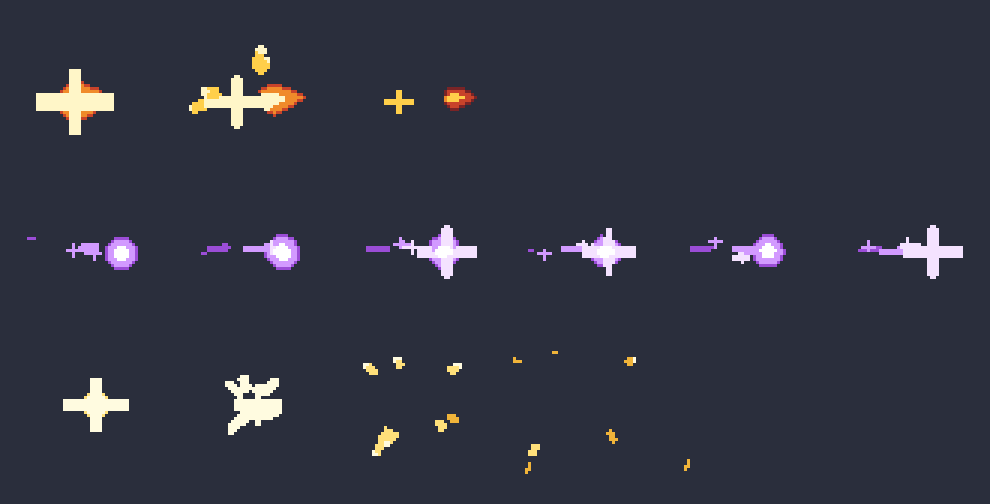
- The muzzle flash. Two to four frames, played once at the barrel, the bow or the hand: a plain bright shape bigger than the projectile, then a little fire or smoke, then nothing. It tells the player who fired, and it hides the frame where the projectile appears.
- The flight. The projectile itself, moved by the game. A bullet or an arrow can be one frame; a spell loops on four to eight. Its head keeps its size and place in the cell, the trail behind it changes every frame, and a frame with a flare (the third and sixth here) makes it sparkle.
- The hit. Four to eight frames where it touches: one frame of a plain light shape, then a burst, then a few sparks or chips flying off. A projectile that just disappears feels like a miss.
The flash and the hit are where the strength of a weapon shows. A pistol and a cannon can fire the same bullet; one has a small flash and a spark, the other a big flash and an explosion.
Shapes and sizes
Keep every projectile of a game on one scale, against your characters’ height (see sprite sizes):
| Projectile | Size for 32 px characters | Frames in flight | Shape |
|---|---|---|---|
| Bullet | 2 to 4 px | 1 | a bright dot or dash, a one-pixel streak behind |
| Arrow, bolt | 8 to 12 px | 1 | a line with a head and two fletching pixels |
| Magic missile | 6 to 10 px | 4 to 8 | a round light head, a broken trail |
| Fireball | 8 to 16 px | 4 to 8 | a hot head, a flame tail |
| Laser bolt | 6 to 12 px | 1 to 2 | a short bar, lightest in the middle |
| Cannonball, rock | 4 to 8 px | 1 to 4 | round, shaded, an outline |
- Light at the front. The lightest pixels lead; the tail is darker and cooler. The eye reads that as the way it flies.
- No outline on light. A bullet, a laser or a spell is the light, so it has no dark outline; the darkest step of the trail does that work. A solid thing (an arrow, a rock, a cannonball) keeps its outline and shading like any prop.
- Pointed along its path. Draw it flying right. A round projectile never needs turning; a long one aimed in many directions should be drawn at 8 or 16 headings, like a turret, rather than rotated freely by the engine.
Colours
Colour says whose shot it is and what it does. The same missile in four ramps:
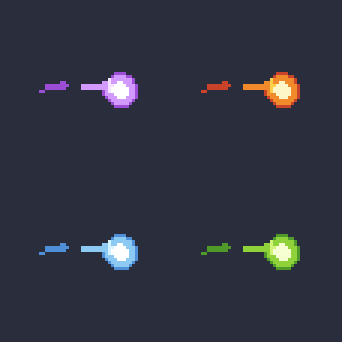
- One colour per side. In a game with many shots, give the player’s projectiles a colour no enemy uses, and keep enemy bullets the brightest, most contrasting thing on screen: they are what the player must dodge.
- One ramp per element. Fire is warm white, yellow and red; frost white and blue; poison yellow-green and green; magic white and purple. Keep three or four steps of one hue-shifted ramp.
- Darker than the ground. The darkest step of the trail must be darker than every background the projectile flies over, or it loses its shape.
Making projectiles with Pixor
Pixor draws all three sprites as effects, in the same pixels, palette and light as your models. The pictures above:
pxr effect "muzzle-flash:4" --preset selout --size 48 -o flash.png
pxr effect "magic-missile:8,ramp=frost" --preset selout --size 48 -o missile.png
pxr effect "hit-spark:6" --preset selout --size 48 -o hit.pngmagic-missile,fireballandmuzzle-flashfly along+x;ramp=is their colours:magic,fire,frost,poison… or your own#rrggbbcolours, dark to light.- A recipe chains effects with
>:"magic-missile:6,path=-1.6,0.4,0:0,0,0>hit-spark:6@land"flies the missile along a path and starts the hit where it lands, in one sheet. beamis a laser beam held on the target, andexplosionthe big hit.
On a model, --effect "muzzle-flash@Fire:Muzzle+2" puts the flash at the part or bone Muzzle from frame 2 of the clip Fire, so the gun and its flash come out of one render; render the model at 8 or 16 headings and the flash turns with the barrel. Every setting is in the manual’s pixel effects.
Questions
How do you draw a projectile in pixel art?
Small, bright and pointed along its path. Put the lightest colour at the front, a darker tail or streak behind, and no outline: the darkest pixels of the tail do that job. A bullet can be two or three pixels with a one-pixel streak; a magic missile is a round head of four to six pixels with a short broken trail. Draw it facing right and let the game move it.
How many frames does a projectile need?
A bullet or an arrow can be one frame. Anything made of energy loops on four to eight frames at 10 to 15 frames a second: the head keeps its size and place, the trail changes shape, and one frame with a small flare makes it sparkle. The muzzle flash is two to four frames, played once; the hit is four to eight.
How big should a projectile sprite be?
For characters of 32 pixels, a bullet is 2 to 4 pixels long, an arrow 8 to 12, a magic missile or fireball 6 to 16 with its trail. Keep the projectiles of one game on one scale: the bigger the shot, the slower and stronger the player expects it to be.
Should projectiles rotate in a top-down game?
Only at whole steps the pixels survive. A round magic missile needs no rotation at all. A bullet or an arrow aimed at any angle should be drawn or rendered at 8 or 16 headings, the way a turret is, and the game picks the nearest; turning one sprite freely blurs or breaks its pixels.
What makes a shot feel strong?
The two sprites around it. A big, short muzzle flash at the start and a bright hit spark at the end do more than the projectile itself: one frame of a plain light shape bigger than the shot, then a few sparks or debris flying off. Add a pixel or two of screen shake and a one-frame hit stop on the target.