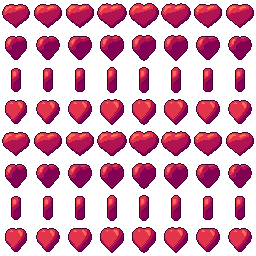
Heart free 3D model & sprite sheet
2D pixel art by Pixor, from the 3D model
3D the model it was rendered from


GIFs to share
For a devlog, a post or a Discord message. CC0 like the rest: no credit needed.
A puffy red heart that pulses gently, the universal sign for health. The model is a thick rounded plate with a soft rim, so it reads as a solid object rather than a flat shape, and the sprites show it swelling and settling in a calm loop that suits both a pickup and a health bar.
The heart starts as one outline. Its rounded rim is lofted from offset copies of that outline, and the halves are sliced from the very same outline, so every variant lines up exactly. Those variants live in the extras: an empty heart in dark iron and a half heart that is full on the left and empty on the right.
With the full, half and empty hearts you can build the classic row of health containers seen in action adventures and roguelikes. Use the pulsing full heart as a drop that restores health, then reuse still frames of all three for the HUD. The pulse is added by Pixor when it renders, not keyed in Blender.
As a pickup the heart is centred in its 32-pixel cell. To make a shield or mana meter instead, swap the red material for blue or gold and render again. It pairs well with the potion for a second kind of healing item.
Use it in your game
- Godot 4:
godot/heart-selout-32.tresis aSpriteFramesresource with 8 animations (pulse_South, pulse_Southeast … pulse_Southwest): drop it on anAnimatedSprite2Dand playpulse_South. - Aseprite:
aseprite/heart-selout-32.asepritehas a tag for each of those, 64 frames in all, to touch up by hand; its.jsonsits next to it. - Unity, GameMaker and the rest:
sprites/selout/heart-32px-8-sides.pnghas 8 rows of 32×32 px cells, one per action and side, South (front) first. A 4-side sheet and the 48 and 64 px sizes are next to it. - Posts and devlogs: the GIFs above, also in the zip’s
gifs/folder. - 3D: the GLB opens in Blender, Godot, Unity and three.js. The
.blendkeeps its modifiers, named parts and materials.
How this look was made
The sprite above is Pixor’s selective outline look. In Pixor every step of a look is a node you can change: the light bands, the outlines, the palette. This is that look’s Style graph:

- dither
- 0
- fill
- 0
- hysteresis
- 0.05
- min highlight
- 2
- rim
- none
- shadows
- on
- specular
- 0.96

- convex
- none
- crease
- selout1
- crease angle
- 55
- depth jump
- 2.5
- inner
- selout2
- min inner line
- 3
- outer
- selout3
- outer inside
- off
- part lines
- on


The other looks in the player (clean, retro, flat) are other Style graphs. With Pixor you can open this asset, change any node, and render your own.