Grass tuft free 3D model & sprite sheet
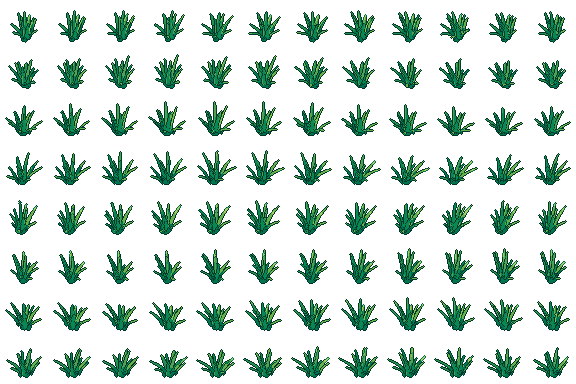
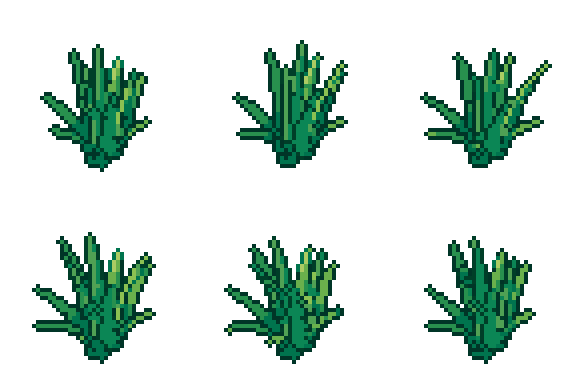
2D pixel art by Pixor, from the 3D model
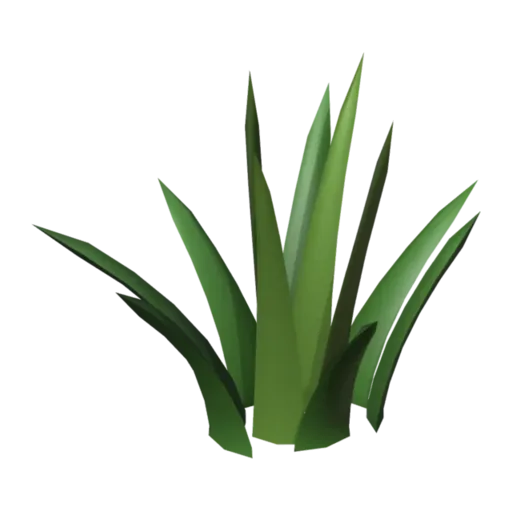
3D the model it was rendered from

GIFs to share
For a devlog, a post or a Discord message. CC0 like the rest: no credit needed.
A tuft of curved, pointed grass blades in two greens, fanned out from one spot. In the Sway loop the blades bend together in a gust and spring back. At 48 pixels from a three-quarter view, it is the basic ground detail you scatter everywhere to make flat tiles feel alive.
Each blade is swept along a curve as a thin closed shell rather than a flat plane, so it renders cleanly from any side without vanishing edge-on. The blades are grouped into fans, and shape keys bend them for the sway. The two tones come from the Grass and Light leaf materials.
Grass tufts are the most repeated prop in many top-down and side-view games. Use them to mark walkable meadow, hide small pickups, or react when the player walks through. Place them in loose clusters rather than a grid, and offset the start frame of each so they do not sway in lockstep.
For dry or autumn grass, turn the two greens towards yellow and brown, or towards a pale blue-green for a frozen tundra. The tuft pairs with the flower patch and bush for ground cover, and softens the base of the oak tree, rock set and fence.
Use it in your game
- Godot 4:
godot/grass-tuft-selout-48.tresis aSpriteFramesresource with 8 animations (Sway_South, Sway_Southeast … Sway_Southwest): drop it on anAnimatedSprite2Dand playSway_South. - Aseprite:
aseprite/grass-tuft-selout-48.asepritehas a tag for each of those, 96 frames in all, to touch up by hand; its.jsonsits next to it. - Unity, GameMaker and the rest:
sprites/selout/grass-tuft-48px-8-sides.pnghas 8 rows of 48×48 px cells, one per action and side, South (front) first. A 4-side sheet and the 32 and 64 px sizes are next to it. - Posts and devlogs: the GIFs above, also in the zip’s
gifs/folder. - 3D: the GLB opens in Blender, Godot, Unity and three.js. The
.blendkeeps its modifiers, named parts and materials.
How this look was made
The sprite above is Pixor’s selective outline look. In Pixor every step of a look is a node you can change: the light bands, the outlines, the palette. This is that look’s Style graph:

- dither
- 0
- fill
- 0
- hysteresis
- 0.05
- min highlight
- 2
- rim
- none
- shadows
- on
- specular
- 0.96

- convex
- none
- crease
- selout1
- crease angle
- 55
- depth jump
- 2.5
- inner
- selout2
- min inner line
- 3
- outer
- selout3
- outer inside
- off
- part lines
- on


The other looks in the player (clean, retro, flat) are other Style graphs. With Pixor you can open this asset, change any node, and render your own.